1928 Olympics in Amsterdam gave the world a star. A 22-year-old Lance Naik from the Indian Army, named Dhyan Chand, enthralled the audience, made journalists and viewers suspect the laws of gravity and infuriated the officials to an extent wherein they had to break open his stick to check for magnets inside. Well, some of this is hearsay but Dhyan Chand’s tally of 14 goals in 5 games, can describe India’s domination in the 9-team tournament as accurately as possible. India scored 29 goals and conceded none. But in this team of champions, there is one person who is often overlooked. Probably because he stumbled just before the final hurdle, but that hardly makes his contribution any less important. He was a person who graciously contributed to not only hockey but human lives as well. It was the captain – Jaipal Singh Munda.
Promod Pahan was born in 1903, in Takra village in Bihar’s Ranchi province. He belonged to a family of forest dwellers of the Munda tribe, who were known as ‘janglis’ or ‘adibasis’. His parents, who were tribal farmers, had embraced Christianity and as a result, Promod was enrolled in Ranchi’s prestigious St. Paul’s school under a new name ‘Jaipal Singh’. This is where Jaipal’s prodigious talent came to the fore.
The school principal Canon Crosgrave, recognizing his talent, took Jaipal under his wing and brought him to England in 1918. In 1922, Jaipal Singh got enrolled in the University of Oxford. This was where Jaipal got acquainted to the sport of Hockey. He wasn’t the tallest of figures on the field, but his command and control over the stick aided him in becoming a dependable deep-lying defender. His hard hits and tackling, he worked upon and improved with time. Soon enough, he was an Oxford Blue in hockey. But merely being in the team was never enough for Munda. He was meant to be a leader.
And as fate would have it, Jaipal Singh Munda was chosen to lead the Indian Hockey Team in their first-ever appearance in Olympic Games in 1928. There were ripples of dissent with his appointment, but Munda never bothered himself with speculation and rumours. His sole focus was on leading his 16-member team to victory. He was one of the three players hailing from Britain alongside Syed Yusuf and Nawab of Pataudi Sr. to be selected in the squad. India played a friendly game in London en route to Amsterdam. Such was the power of their performance in that match, that it is believed the England team, who were watching India play, decided to withdraw from the Games fearing they’ll face a humiliating defeat if pitted against that Indian side. This was the same England team that had bagged a Gold in the 1920 Olympics.
The Indian Hockey Team at 1928 Amsterdam Olympics
The Indian team, to the surprise of everyone, completely steamrolled every opponent they faced. In the four group games they faced against Austria, Belgium, Denmark and Switzerland, India scored a total of 26 goals and allowed none. Nobody, well; apart from the England side, expected the newcomers to outclass all opponents. But just before the final, India were handed a major setback. Jaipal Singh Munda decided to pack his bags and return to London. The reasons for this withdrawal are still unknown and speculated to a large extent. Some claim that he had a rift with the team manager, while others say that he had to return to appear for his Civil Services exams. Luckily for the Indian team, their vice-captain Eric Pinniger took charge and they won by a scoreline of 3 goals to nil. Dhyan Chand was the star again, with a hattrick in front of a jam-packed Olympic Stadium which seated 24,000 spectators. Unfortunately for Munda, that was the last he would see of the green turf of a hockey field.
Jaipal Singh Munda’s streak of bad luck did not end at the Olympics. Back home, he was debarred from the Civil Services exams, claiming that he had flouted terms of his probation period by joining the Indian team in the middle of his service tenure. Miffed at the prospect of repeating a year, he decided to quit the profession and took up teaching in Ghana.
But as is the case with all visionary leaders, Jaipal Singh Munda was relentless. After returning to India in 1937, when he was the principal of Rajkumar College in Ranchi, Munda became aware of the atrocities that the people of his native village and its nearby areas faced. And the remainder of his life became a mission to alleviate those problems.
In 1940, he became the president of Chotanagpur Adivasi Mahasabha which was extensively involved in the demand of a separate state for the tribal natives. Jaipal Singh Munda was also elected to the Constituent Assembly in 1946, as a representative of the tribal population. Being an exceptional orator, some of Jaipal Singh’s speeches addressing the assembly hold a special place in the hearts of his admirers.
Today, 50 years after his demise, Jaipal Singh Munda continues to be a beacon of hope for the people and youth of Jharkhand. The state – Jharkhand – which Munda envisioned, is a hotbed of hockey talent in the country. Though the people still struggle for land rights and basic facilities, they now know how to fight for what they deserve. The credit for this, among others, goes to Jaipal Singh Munda. And as far as the sporting world is concerned, Munda will always be the first captain to get India a hockey gold.
Cricket is a euphony! Beyond the scintillating cover drives and the red cherries nipping in and out, which usually capitulate the attention of the viewer, cricket is pleasing to the ear. It has been made so by a league of extraordinary gentlemen, who have, by their sheer tenacity, created a beautiful concoction of cricket and phonaesthetics. A well-timed cover drive would be incomplete without an accompanying sentence from a commentator expatiating it. Commentary was first used in 1927, in a first-class match between New Zealand and Essex, on BBC. This was the first time that people were acquainted with ball-by-ball commentary, and the art hasn’t looked back since. It has become an indispensable part of the game. Cricket legends, like Richie Benaud and Tony Greig, took up this art after drawing curtains over their playing days. And it’d be fair to say, they were just as brilliant behind the microphone as they were on the field. John Arlott, Alan McGivlray and Brian Johnston were another few important exponents that helped in increasing the reach of the sport, by giving their voices to cricket. India, too has had its share of commentators who were pivotal in popularizing the sport across the country. But the challenges for Indian commentators were more. In a country where the masses enjoyed the game in open ‘maidaans’, it was quite a task to get everyone behind their national team. Though the national team had its own following, it was in local cricket where the country’s heart resided. It was in a local cricket tournament – The Bombay Quadrangular – where India found its first cricketing voice. Ardeshir Furdorji Sorhabji Talyarkhan, popularly known as ‘Bobby’, was appointed to commentate during the Bombay Quadrangular in 1934. The Quadrangular, which later became the Pentangular, was a feisty tournament. The teams, based on religious grounds, competed fiercely till the last minute. But, despite criticism from various portions of the country for having teams based on communal grounds, ‘Bobby’ Talyarkhan’s extraordinary exploits behind the mic saw the popularity of the tournament grow. Few of the matches of the tournaments reached a fever pitch across the country. It was not that people liked the idea of teams having players of different religious beliefs being pitted against each other, but it was the cricket and how it was described, which the audience marvelled at. Eventually, the Bombay Pentangular was abandoned by the Board of Control for Cricket in India in 1946, but ‘Bobby’ Talyarkhan had become the articulate voice of cricket in India by then. He became a regular on All India Radio for all matches played in India. Ramachandra Guha, in his book ‘On the corner of a foreign field’, describes Talyarkhan: “he brought to cricket broadcasting a rich, fruity voice and a fund of anecdotes. He was ambitious and opinionated, with a voice that was beer-soaked, cigarette-stained.” Another remarkable quality possessed by Talyarkhan was his ability to narrate the game for long hours. He commentated alone for the entire duration of a test match. That makes it 5-6 hours of continuous talking for 5 days in a row. A thought which would be unimaginable for modern-day commentators, who work only in half-hour shifts. Yet, Talyarkhan sailed through the routine effortlessly. He was particularly adamant on commentating alone. He would have it no other way. And due to this, after West Indies tour of India in 1948/49, Talyarkhan parted ways with AIR after they were reluctant to let him commentate alone. He did make brief return stints to commentary but nothing as prolonged and enriching as his first spell. He preferred writing cricket columns, instead. Despite an early exit, Talyarkhan remains India’s first cricket commentator. He even commentated on other sports broadcasts like Hockey and Cycling. But for cricket, he set a platform which would make Indians embrace the foreign sport of their oppressors with open arms in the years to come.
In the following decade, the baton of Indian commentary passed on to the serene voice of Anant Setalvad. He was the new flagbearer of an art which was meant to enthrall masses larger than ever before, by encapsulating cricket and its minutiae to the eager audiences. Talyarkhan made it reach into the hearts of every Indian, Setalvad had to ensure it stayed. He managed to do that and much more. Anant Setalvad, born and brought up in Bombay, had himself played as a cricketer for CCI in the 60’s before eventually taking up the trade of cricket commentary. He was a commentator like no other. Where most commentators tried to hype their depiction of an order of play to get their listeners on edge, Setalvad had them hooked with his tranquil baritone. Never did he engage in over-the-top, larger than life description of events. Rather, he was always articulate and concise, providing the listeners with everything required to paint a picture of the events in their heads. Much like Richie Benaud, Setalvad was pleasing to the ear. The listeners simply wanted his melodious speech to go on endlessly. This was an era when Television was a luxury only a handful could afford, and radio sets were making their ways into the homes of people. Setalvad’s voice reverberated the atmosphere in stadiums into people’s living rooms. It felt as though the entire room transcended onto the ground. Right from the direction of the blowing breeze, to the colour and cracks on the pitch, Setalvad enchanted his listeners with every last detail. His nuanced and astute commentary hardly had any dose of hyperboles or unfunny cracks at humour. He had equally able partners in Dicky Rutnagur and Suresh Saraiya, and the trio had Indian audiences glued to their radio sets, with contributions from former India batsman Vijay Merchant. Anant Setalvad managed to inspire an entire generation to avidly follow the game and even take up the art of commentary. One of the best of the current lot, Harsha Bhogle, recalled on Setalvad’s sad demise, how he used to imitate Anant: “As a young man, I imagined I was Anant Setalvad and I would try to copy his style but could never get the lilt and authority that his distinguished voice produced. He was always the commentator I wanted to be. The brightest light in the finest era of radio broadcasting in India.”
But, despite Setalvad making great inroads into popularizing the sport, one key aspect was still missing. And in came an 18-year-old from Indore, Sushil Doshi.
All India Radio, in 1968, was looking for a Hindi commentator for its broadcast of the Ranji Trophy. Hindi commentary was an unknown craft at that time. Sushil Doshi, then a college-going student, went for the audition and was initially rejected. It was only when the producer was unable to find anyone else that he decided to give Doshi a chance. This decision turned out to be a landmark for cricket commentary in India. Sushil Doshi’s voice struck a chord with the Indian masses. Within no time, Doshi was commentating side by side Setalvad. A pair of English-Hindi commentators allowed more people to connect with the sport. There was no longer any distinction between listeners. Be it a rich businessman sitting in his office or a rickshaw puller at the side of a road, for the duration of the match, they were simply two ardent cricket lovers who wanted to hear their team play. Doshi’s imagery and aural abilities were top-notch. Right from the crackle of the ball hitting the middle of the bat, to the thud when it struck a batsman’s pads, Doshi would cover it all. What stood out was Doshi’s intricacy and eye for detail. He would take great efforts to describe the field positions after every couple of overs. For Doshi, it was extremely important to describe the entire process of stroke-making, action by action. He would start from how the bowler was running up to the crease and how the batsman stood, followed by where the delivery was pitched and how the batsman played his stroke. Like a chain reaction. Doshi converted figurative poetry in motion, happening on the field, into actual poetry through his melodious voice and compendious choice of words. On the other end of the microphone, millions of listeners used to be gelled to their radio sets. With bated breathes, and on the edge of their seats, they followed Doshi’s each and every word. This was Sushil Doshi’s ‘Aankhon Dekha Haal’, which took Indian cricket from the colossal stadiums to the narrow ‘gallis’ of every ‘mohallah’, from the press boxes to the ‘nukad chaiwallas’. Cricket was now a viral fever. It was being discussed at markets, shops, offices and at homes it was a part of dining table conversations. Every match India played was a festival, wherein each and every member of the family had to join and be a part of.
Another big reason for this increase in popularity was that India had started performing consistently. They were winning matches not only at home but abroad as well. The likes of MAK Pataudi, Sunil Gavaskar and Bishan Bedi had found a place in every Indian’s heart, across generations. All India Radio and its commentary teams had been at the centre of this rise and adoration. They gave a first-hand account of it.
But the waves of change hit radio broadcasting hard.
The late 70’s and early 80’s brought the advent of Television broadcast. The famous English commentator John Arlott believed that in radio commentary, the commentator was the hero; the entire focus was on the words of the speaker. With TV coverage, however, the screen was the hero. Vivid description from the commentator was left unpraised when the exact scene was in front of the viewers in motion. It was one of those classic scenarios where a machine had rendered a manual effort useless. Times changed, broadcast methods changed, and so did the art of narrating events. The modern-day commentators were supposed to play a secondary role. It was no longer about simply describing events, they now had to analyse the performances. They had to make the audience understand why things happen the way they do. There have been ample who have succeeded in this new form. But due to the scope of modern commentary being largely technical, the trade is now dominated by former cricketers. Radio commentary nowadays survives, barely. There are only a handful who still feature in radio broadcasts, Sushil Doshi being one of them, but radio commentary’s time is long gone. It’s magic and aura, though, still afresh in its nostalgia for its listeners, like a dictophone replaying in their hearts.
The realisation has been stark, the wounds deep; for quite some while now. Manchester City are no longer the champions of England! ‘The Reds’ from Merseyside have dethroned them. In spectacular fashion at that! The aura of invincibility that accompanied the City team has been blown away by the cold, chilly winds of Liverpool. What remains, is an able group with an equally able manager, who have been left chasing shadows.
Pep Guardiola and his men have their task cut-out. The knockout punch from Liverpool has been firm and hard to take. But the time for action is now. Pep needs to go back to the tactic board and rework a few key details. Here is a look at the areas which Manchester City need to sort out, to come back a stronger team next season.
End on a high
One of the perks of managing a club like Manchester City is that there is no dearth of opportunities. Pep had conceded in press conferences and interviews that the Premier League race is all but over. City, however, find themselves in FA Cup Semis, enjoy an away lead in UCL round of 16 to Real Madrid and have secured the Carabao Cup. If City can finish strongly in these three, coupled with a resilient display in the remaining 7 fixtures of Premier League, it would be a fair reparation for letting the league slip out of their hands. Champions League, in particular, would be Pep’s priority. With the club handed a two-season ban from the competition, and their appeal yet to be heard by CAS, this could be the last shot City have at the elite trophy in some while.
Transfers
This, perhaps, is one area where Manchester City need no guidance. If spending money was an art, Manchester City would be Michelangelo. They’ve proven it time and again. Pep would certainly want his rich Arab bosses to roll some moolah into the transfer market, yet again.
Since the resumption of Premier League, post the coronavirus lockdown, Manchester City have launched a campaign – We’re not really here – based on the iconic chant sung by City fans since long, to show support for their players. The same phrase could be used by City’s defence this season – We’re not really here. With Aymeric Laporte injured for a major part of the season and Kompany leaving the club last summer, City’s defensive frailties came to the fore. On occasions, it has been absolute shambles. Fernandinho has tried his best in his new makeshift role, but he has had no help from the other end. Stones and Otamendi have regularly struggled to make an impact and maintain a prolonged and firm spot in the team. Manchester City have already conceded 33 goals this season, with 7 games remaining. During the last two seasons, this number has been 23 and 27, respectively. Hence, signing a centre-back will be the topmost priority for the club. They have even been linked to Napoli player Koulibali. Though, the young Eric Garcia has shown promise; securing a centre-back, will undoubtedly, strengthen Pep’s team to a greater extent.
Another post that City need to fill-in next season is the one vacated by David Silva. Silva has, inarguably, been a stalwart for the City team. Even before Pep’s arrival. He has orchestrated the team with his sumptuous, one-touch, accurate passing. It would be quite a challenge to replace someone with as immaculate a vision as David Silva. Many consider Phil Foden to be the natural replacement. And the 20-year-old Mancunian has indeed justified the faith shown in him. But not signing a midfielder will leave their midfield down to bare bones. The only midfielders remaining in the squad will be Rodri, Gundogan, De Bruyne and Foden. This thin a line-up, will not bode well in a gruelling season, where teams are required to play 3 games a week, and injuries constantly trouble players. Moreover, Pep’s fascination with constantly rotating his team would certainly entice City to buy a central midfielder.
Choosing a Captain
A leader like Vicent Kompany comes once in a generation, the man who saw the charge of Manchester City, as they established themselves as a powerhouse in football. He won four Premier Leagues with City. Naturally, his departure has left a void that will be hard to fill. Silva was given the captain’s armband and rightly so, but he too, is on his way out. This leaves a dilemma for Pep, to select a player who can lead the team on their way to recovery. Kevin De Bruyne, Sergio Aguero and Raheem Sterling are the natural candidates. Sterling has failed to maintain a level consistency on the pitch, while Aguero has had his troubles off the field. Kevin De Bruyne is the perfect solution. The Belgian has had a terrific, personal-best season and would surely love to don the armband. He is at the peak of his career and is a player his teammates can look up to. De Bruyne has all the abilities to lead the team from the heart of the midfield.
Kevin De Bruyne has tallied 18 assists this season, in all competitions
Consistency
This is the area, Pep would grievously want to work on. Manchester City has simply been inconsistent this season. No number of signings can work if the players who are not a part of the team do not contribute. Right from defence to attack, City players have let themselves and their team down. Raheem Sterling, who had established himself as a prolific goalscorer, in the previous seasons, has failed to keep up with that reputation. He not only scored, but created chances for his teammates as well. This season though, time and again, Sterling has been a tad selfish and failed to recognise players in better scoring chances. In the last 2 seasons, Sterling managed 15 and 13 assists, respectively. This season, the number has fallen to 4.
Another City player who needs to step up is Bernardo Silva. He has managed a paltry tally of 6 goals and 8 assists this season. His campaign took a turn for the worse after he was accused of passing racial slurs to teammate Benjamin Mendy, for which he was banned for a couple of games. In the past seasons, Bernardo used to come on as an impact substitution, and find wins for his team. His inability to replicate that has been an added burden on Pep.
And as almost every football pundit has advised, City’s defensive line-up needs to find its feet. And not just the centre-backs, but the full-backs as well. Apart from Walker, every City full-back has struggled with some issue or the other. Cancelo has still not earned Pep’s full faith, Mendy has struggled with a recurring knee injury, and Zinchenko has struggled to establish his place in the team. To make a formidable starting line-up, the defence has to step up and become the backbone of the team.
The clock is ticking. Manchester City need to find solutions. The goliath-like team that Liverpool have built, has the potential to create a hegemony and rule English football for the next decade. City would be the favourites to break that. They have experience of winning, they will have the world-class players they need, and they have a manager who can deliver. If the resources are channeled in the right direction, it won’t be long before we see Manchester City back at the pinnacle of English football.
There is hardly a sport in the world as faceted as Formula 1. Right from its cars, the modern-day technological marvels; to the nip and tucks of a chicane and the two-second pit intervals, F1 gives you no time to blink. Constant updating of guidelines from FIA, followed by innovative brainstorming by team engineers, have ensured that Formula 1 has maintained its position at the zenith of the motorsport world.
Come to think of it, F1 constantly challenges the threshold. It is their constant pursuit to improve; to get faster, to work economically, to outfox rivals. This pursuit makes way for a blurred distinction between motorsport and madness. And this blurred distinction, from time to time, pushes the sport towards madness. The San Marino Grand Prix, 1994 is a perfect example.
The Italian Grand Prix was the third race on the calendar and Schumacher, leading the Drivers’ Championship with 20 points, was already giving glimpses of his erudite abilities. Few of the other stalwarts in the hunt for the Championship were Damon Hill, Aryton Senna and Gerhard Berger. Unlike current races, the Italian Grand Prix followed a different three-day schedule; with a first qualifying session on Friday, a second qualifying session on Saturday and the Main Race on Sunday. The first accident took place on Friday, 29th April.
Jordan driver Rubens Barrichello, or ‘Rubinho’ as he was popularly known, was a season old in F1 and was sitting at a modest second position in the Drivers’ Championship, albeit with a deficit of 13 points to Schumacher. During the first session, ‘Rubinho’ heading to Variante Bassa corner, understeered and hit the kerb. This resulted in his car being flung into the air towards the tyre-barrier at 140 mph. The tyre-barriers, unlike today, did not have a sheet covering over them. The sheet covering helps in absorbing the blow, by co-joining multiple tyre clusters. In absence of the sheet, the car ricocheted off the tyre cluster that it hit. Barrichello was knocked unconscious and the car toppled to a halt. The medical team delivered the treatment on the spot and ‘Rubinho’ was airlifted to a hospital. He was lucky to end up with only a broken nose but was ruled out for the remainder of the race weekend.
Race crew attending to Barrichello after his crash.
The drivers were able to shake-off this accident but what followed over the next two days, jolted not only the drivers but the entire motorsports world, to its very core.
Twenty minutes into the second qualifying session, tragedy struck Roland Ratzenberger. Driving his Simtek, the Austrian misjudged a chicane and collided head-first with a concrete barrier. The grass-covered run-off area, adjacent to the track, could only partly slow down his momentum. His car slid along the wall for close to 20-25 metres before coming to a halt. The entire left portion of the car had been obliterated. The first glimpse of Roland’s head hanging, with his body lying motionless, sent shock-waves across the world. The session was stopped. Ratzenberger too, was airlifted to Maggiore Hospital where he eventually succumbed to his injuries. This was a hard blow. The accident, once again raised the incontrovertible question – Are we taking it too far? Further analysis of the accident revealed that Roland had damaged his front wing one lap before the accident, thereby reducing his ability to control the car. Roland decided not to fix it and continued with his qualifying lap. It was his reluctance to return to the box that proved fatal.
Ronald Ratzenberger after crashing his car at San Marino Grand Prix, 1994
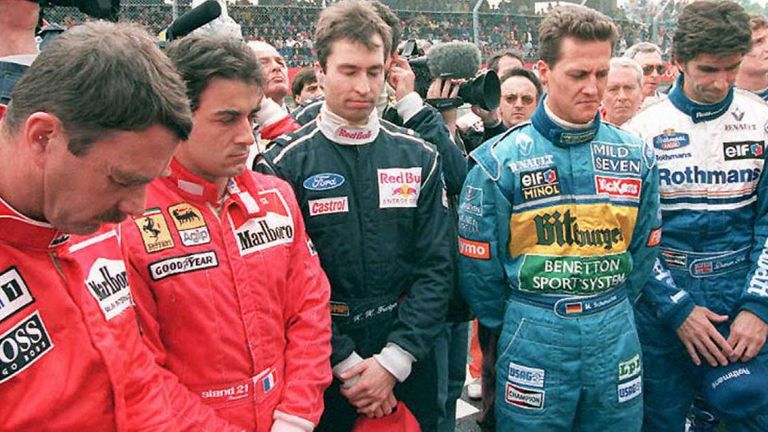
The following day, the Grand Prix Drivers Association was re-formed. A body that would work for the safety and well-being of F1 drivers and alleviate any issue drivers may face. Senna, Berger and Schumacher were the first directors.
But the catastrophe had still not passed.
On the starting grid, Senna took the Pole followed by Schumacher and Berger. Just as the race started, Portugese driver JJ Lehto, who started fifth, saw his car malfunction and stop. Pedro Lamy, who was starting way behind at the 22nd place, was blinded to Lehto’s motionless car stuck in the middle of the track. Lamy, in full steam, rammed into Lehto’s car. The debris from the impact flew over the protective fence, into the spectator area. 8 people including a security personnel were injured. The safety car was introduced in the first lap itself, while the race crew cleared the track of all debris. Normal proceedings continued from the fifth lap.
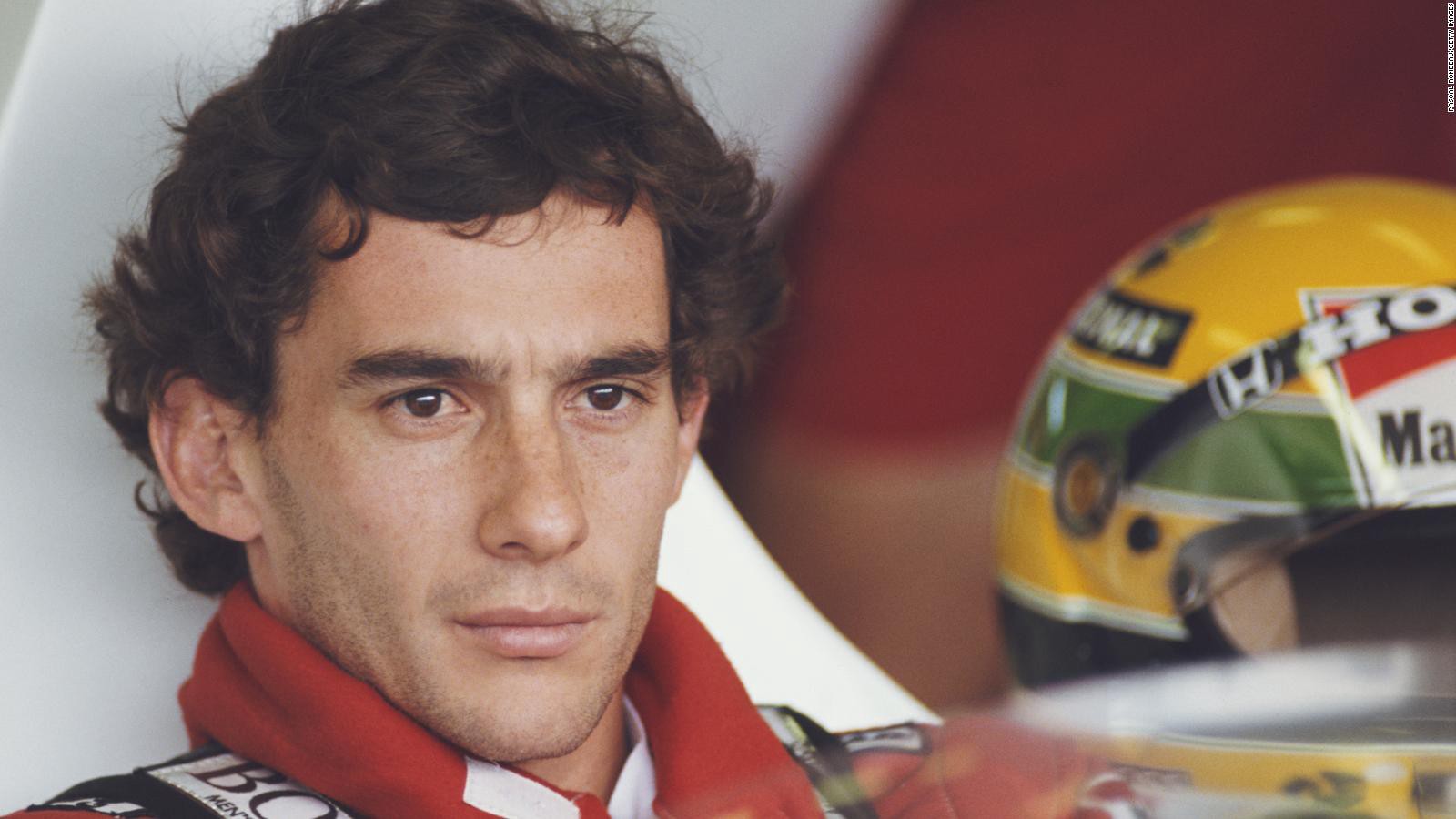
But just when the racers were settling in, F1 witnessed a crash that completely changed its views on driver safety. Senna, in the following lap, charging through the Tamburello corner, could not control his car and crashed into the concrete wall. This was the fourth major accident of the weekend. This one, undoubtedly, is the most talked about. A helicopter shot captured a slight movement from Senna in his seat, giving some hope to viewers that he might be all right. The scenes were horrific to the extent that BBC had to switch its feed cameras to the pitlane. Senna was moved from the remains of his Williams car and flown to Maggiore Hospital. Around 6, the same evening, Senna was pronounced dead. The cause, as ascertained by the autopsy, were multiple injuries to the head caused by severe impact. A second fatality in as many days.
The race had already seen a subdued end. Once restarted, Schumacher managed a comfortable win with Nicola Larini and Mika Hakkinen taking the podium places. In memory of Ratzenberger, who was the only confirmed casualty till then, it was decided that no champagne will be popped during the podium ceremony.
The legendary BBC commentator Murray Walker termed it as “The blackest day of Grand Prix history I can remember.” Sid Watkins, who was the medical in-charge, revealed later that Senna had been distraught after Roland’s demise. Watkins even persuaded Senna to not race the following day. The three-time world champion, while weeping, replied: “Sid, there are certain things over which we have no control. I cannot quit, I have to go on.” What was even more heartbreaking, was the fact that Senna had carried an Austrian flag during the race. He had intended to offer a tribute to Ratzenberger, had he won the race. The flag was recovered from the wreckage of his car. And in the span of a couple of days two careers; one of a stellar champion, another of a promising rookie in his debut season, were ended. They left a great many questions to answer. Are the tracks safe to drive on? Are the race cars durable enough? Are the safety regulations effective?
Following these events, a ton of work was put in to make F1 safer. The Imola circuit layout was immediately altered with a number of sharp turns and chicanes being modified. The car design was also heavily reworked to incorporate a host of changes to improve the safety standards. Pitlane exits were refurbished too. Safety cars, which were earlier frowned upon, became musts for every race. The run-off areas, gravel traps and tyre-barriers were analyzed in depth to make them more effective. As the years rolled on, further technically tested systems such as HANS(Head and Neck Support System) were implemented into the sport.
More than two decades later, F1 remains a cut-throat, brazen competitive bonanza where teams vie to outwit each other in a nine-month-long gruelling calendar. The safety standards have improved manifold, there are stricter and better laid out instructions and Senna & Ratzenberger continue being the beacons that guide improvement and betterment of the sport.
They had Sobers, they had Gibbs, they had Holder; but you know how it goes, right?
“It was Gavaskar, the real master;
Just like a wall, we couldn’t out Gavaskar at all;
Not at all,
You know the West Indies couldn’t out Gavaskar at all.”
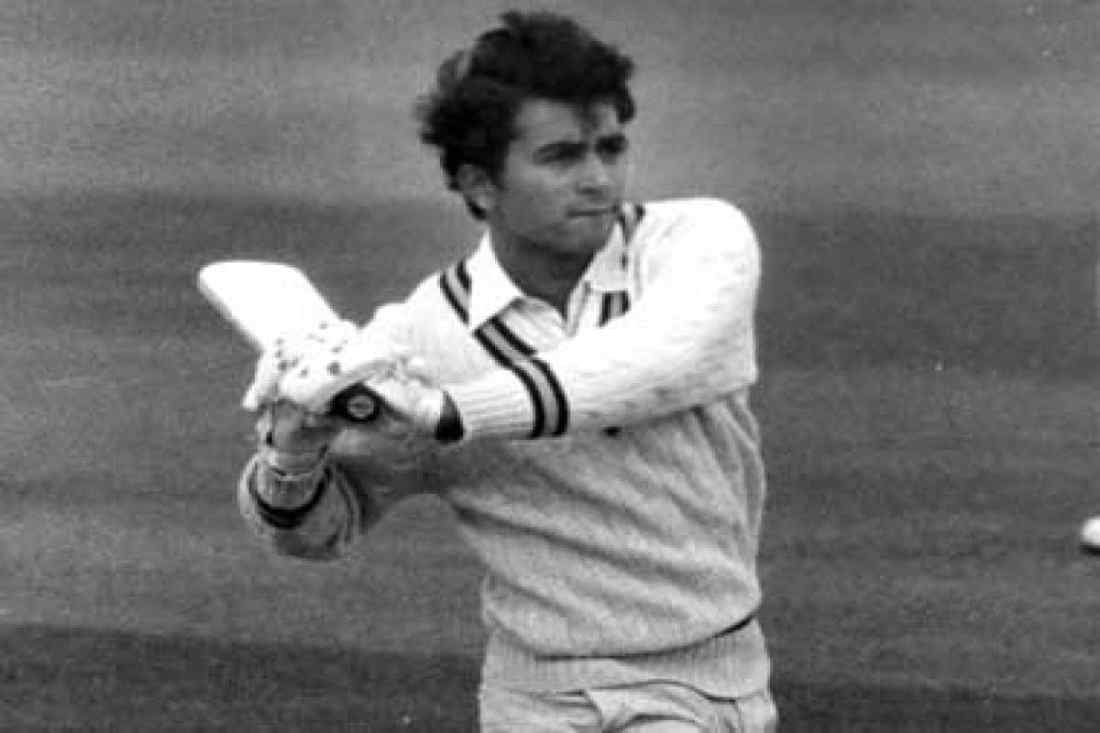
These are the lines from Lord Relator’s Calypso Beat titled ‘Gavaskar’, made in tribute to the Indian Cricket team’s maiden Test series win in the Caribbean in 1971. The series saw 21-year-old Sunil Gavaskar make a swashbuckling entrance on to the international stage. This tour proved to be a teaser-trailer of Sunny’s batting exploits the world would treat itself with, in the years to come.
For the West Indies, in particular, Sunny always had the most special of innings reserved in his willow. Almost like a person, smitten in love, laying a precious piece of his heart, at the feet of his lover. We track how Sunny’s romance with the Windies brew, as he moved along his career.
The debut tour to West Indies, 1971 – Love at first sight.
India had conceded a home series to Australia in ’69 and were looking for vindication. The tour up ahead was against the mighty West Indies, led by the colossal Garfield Sobers. For India, the onus was on the big-guns like Jaisimha, Wadekar, Sardesai and the spin-trio of Prasanna-Bedi-Srini. Little did we know that it would be a young lad from Mumbai, who would decimate the West Indies hopes.
A whitlow ensured that Gavaskar could debut only in the second test of the series. The first test was a draw that saw Sardesai and Kanhai score big hundreds, with the Indian mounting his second double century. The action now moved to Port of Spain.
In the second test, for the first time, out came a young, five-foot-five Mumbaikar, to open the innings for India. Gavaskar managed a fifty and India had a sizeable 1st innings lead. Vice-Captain Venkataraghavan took a 5-fer in the second innings and West Indies were bundled out, giving India a target of 124. Gavaskar, steering the team to victory, managed an unbeaten 67. Such calm and poise from a 21-year-old was exemplary. India wrapped up a win in 4 days and took a 1-0 lead. Port of Spain, however, was yet to see the best of Gavaskar on that tour.
Gavaskar continued his form in the third test. Trailing by 363 runs, Gavaskar anchored the innings on his way to a maiden test century. Sunny navigated marathon spells from their premier bowlers – Gibbs and Sobers – until he was caught by Carew off Sobers on 116. He followed this with an unbeaten 64 in his second stint at the crease while chasing 294. An equally astute knock from fellow opener Ashok Mankad meant that India drew the third test as well.
In the fourth test, Gavaskar was out for 1 in his 1st innings, an aberration in his dream debut series. However, he made up for the 1st innings slip-up by managing an unbeaten 117. But the value of this century was much more. India, chasing 335, found themselves reeling at 3-79. Gavaskar dug in and gritted out a draw for his team. His innings lasted over five hours and he managed to stay at the crease for 103 overs. India’s lead was now unassailable. But the contest, against that West Indies side, was never over. Gavaskar too was up for the challenge, and the little master had saved his very best for the last test match.
Back in Port of Spain for the last match, Gavaskar started immaculately with a score of 124, leading the batting line up from the front. This was Gavaskar’s third ton in consecutive matches. Unfortunately, centuries from Davis and Sobers meant that India had conceded a 166-run lead in the 1st innings. But yet again, it was Gavaskar who paved way for his team with a double century in the second innings. He became only the third Indian to score a century and a double century in the same match. Gavaskar did not allow an inch of opportunity to the hosts. The entire bowling line up was rendered ineffective. When he eventually got out, Sunny had ensured that India were in a safe position with a lead worth more than 200 runs.
The match ended in a draw. India got the series.
Sunil Gavaskar, this short and skinny boy, all of 21 years; had plundered the mighty West Indians in their own backyard. He had scored a total 774 runs in 8 innings, three of these were unbeaten. I’m leaving the average for you to calculate. During the series, Sunny managed to stay at crease for more than 1700 minutes or close to 30 hours. Not too bad for a debutant!
Sunny surely belonged at the highest level. He was more than eager to take on the world and he would stop at nothing.
Gavaskar was not to encounter Windies again until 1974/75.
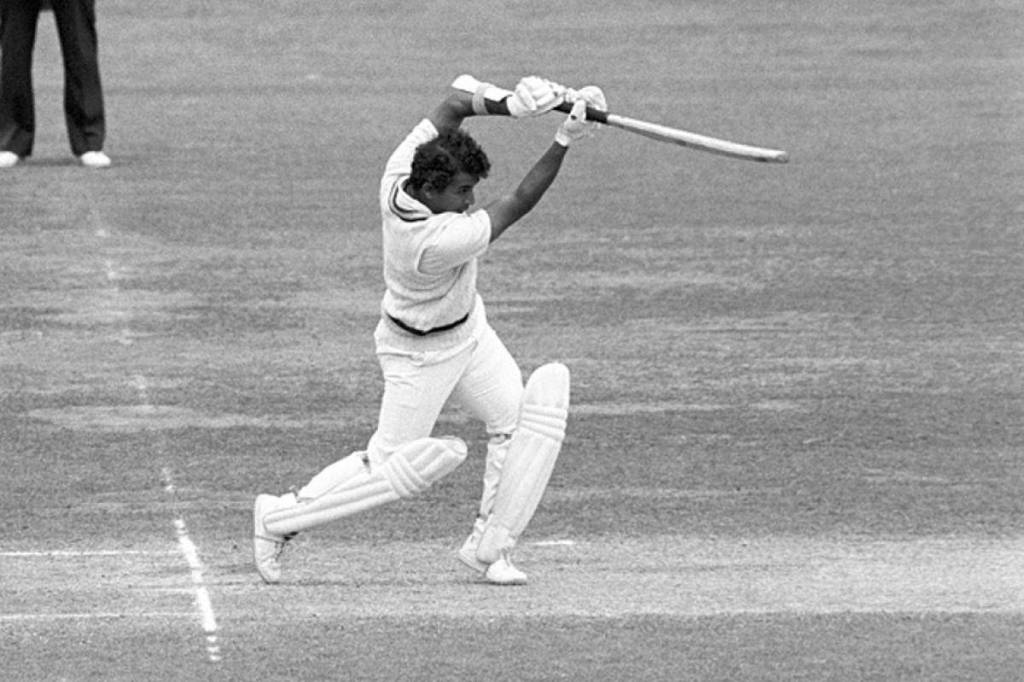
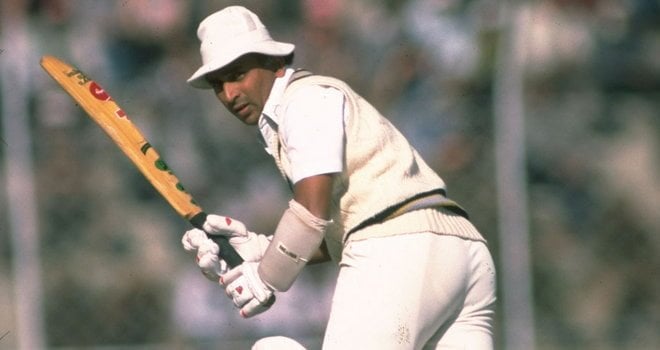
Gavaskar plays a straight drive during his debut series against West Indies in 1971
West Indies tour of India, 1974/75 – A brief re-encounter.
West Indies had been subjected to chopping and changing. The Sobers era was over. Clive Lloyd held the reigns now. The new team was a blend of experience and youth. Old faces, the likes of Holder, Gibbs and Fredricks, were accompanied by newcomers like Greenidge, Viv Richards, Kallicharan and Andy Roberts.
Our little master, on the other hand, was bearing the brunt of the cut-throat world of international cricket. After a blistering start to his career, Sunny had failed to keep up with the reputation he had created for himself. Some critics were demanding his head after a couple of mediocre series against England.
But was this the opportunity to regain his form? Though featuring a few new faces, it was against this very team he made a remarkable entry on the world scene. Could Sunny prove the critics wrong now?
Unfortunately, that was not to be.
Sunil Gavaskar got injured while playing in the Ranji Trophy and could only play the first and the last matches of the series. India lost both.
The series, however, was a rip-roaring seesaw battle between the two teams. West Indies won the first two, India followed up with winning the next two and the 5th match – the series decider – was taken by West Indies.
In the two matches that Gavaskar played, he managed a paltry 108 runs in 4 innings at an average of 27. His tryst with the West Indies was not over just yet.
India in West Indies, 1975/76 – Everything is fair in love and war.
India arrived in the Caribbean on the back of a successful tour of New Zealand. Sunil Gavaskar had gotten the first taste of captaincy in New Zealand after an injury ruled Bishan Bedi out of the first test match. The series was a fruitful one with the bat as well where Sunny managed 266 runs in 3 matches at an average of 66.
The little master was back where it all started for him.
The first test was a nightmare start to the tour as India conceded the match by an innings and 97 runs. Gavaskar got off to a steady start in the 1st innings but failed to capitalise and fell for 37.
The action now shifted to Port of Spain, where Sunny scored a double ton on the previous tour. And like two lovers, Sunny and Port of Spain reunited. His touch was back. It was almost as if he felt at home in the confines of the Queen’s Park Oval. He felt complete. In the 1st innings, Gavaskar scored 156 runs in 352 balls. It took the West Indies bowlers 485 minutes to send him back to the pavilion. Such mammoth knocks, where Sunny dug deep into his reserves of patience, were becoming a trademark of his. India batted only once in the test and it ended in a draw.
The third match was, again, at Port of Spain. India were given the gargantuan task of chasing 403 runs in the 4th innings. But you already know what happened next. Sunil Manohar Gavaskar came to the fore! How could he have not? He set up a beautiful chase with an exhilarating knock of 106 runs. His fourth century at the Queen’s Park Oval. The momentum was carried forward by the ever-dependable Jimmy Amarnath and Viswanath. India won by 7 wickets and the series was all square.
But like all relationships, this one had to go through rocky patches as well. This was evident in the fourth test match of the series. The West Indies resorted to bodyline tactics to counter the Indian batting attack. Things got ugly. A lot was talked about in the media, India complained and West Indies hit back.
It started well for India with both openers getting half-centuries and India was 1 for 175 at the close of Day 1. It was on Day 2 that the endless barrage of bouncers was unleashed on India by Clive Lloyd. Anshuman Gaekwad, Gundappa Viswanath and Brijesh Patel fell prey to the controversial tactics and could not play a further part in the match. After his dismissal in the 2nd innings, Gavaskar infuriatingly walked off the field and kept mumbling and questioning the tactics all the way to the pavilion. India had no answer to such lethal fire-power and could only manage to set a target of 13 runs and the West Indies won the match by 10 wickets and took the series 2-1.
West Indies tour of India, 1978/79 – Affection and Addiction.
When the West Indies came to India; they no longer had to face the young Sunil Gavaskar, the boy who was touted to be a world-class batsman. On this tour, they were up against Sunil Gavaskar – the prolific opening batsman. Sunny had taken every challenge head-on and had amassed runs in every corner of the world. Gavaskar was now counted among the best batsmen in the world. He was particularly successful in Australia and Pakistan, averaging over 50 in both countries. He was rewarded for his stellar contributions by being named as the captain of the side.
West Indies, meanwhile, were world champions and a force to be reckoned with! Their bowling had created a reputation for themselves. Destructive and lethal were a few words which were synonymous with their line-up.
In the first test, Lloyd won the toss and asked India to bat. That decision backfired. Sunil Gavaskar, as elegant as ever, dished out his second double century with a score of 205. In the absence of Holding and Roberts, Gavaskar tormented the West Indies bowlers by staying in the middle for almost 7 hours. What was even special was that this innings came in front of his home crowd at the Wankhede in Mumbai. A sound batting performance by the West Indies ensured a draw. Gavaskar had added another 73 into his tally in the 2nd innings.
Despite not meeting for close to three years, the affection for West Indies was just the same. Deep inside that colossus of a man, there still was a 21-year-old who debuted in 1971. The young bloke for whom the paramount motive of representing his country was the joy and love for the game. That love was palpable when watching the ‘Little Master’ bat.
Sunny continued on his stellar run of form with a century in each innings of the third test of the series. In the 1stinnings, his knock worth 107 made sure India put on a respectable score on board. In the 2nd innings, he and Vengsarkar brought pillage onto the West Indian bowling. Both managed unbeaten tons on their way to a partnership worth 344 runs for the third wicket. Sunny scored 182. India came tantalizingly close but a win ultimately eluded them as they could only pick 9 wickets in the last innings thereby giving a reprieval to West Indies. The series was still square.
The fourth test was a low scoring one, and though Gavaskar did not get big runs, he was meticulous in his man-management and tactics as India got the all-important win and took the lead in the series.
By the start of the fifth test, an already depleted West Indies team had been brought to its knees. The series continued on similar lines. In the fifth test, Gavaskar scored yet another century. Vengsarkar continued his phenomenal run. This series also brought limelight onto a young 20-year-old, a boy that would be known by the name of ‘Hurricane of Haryana’ later on in his career. India piled on 566 runs in their only innings but still failed to win the match.
The last match of the series was a high scoring draw with only two innings played. Gavaskar managed a paltry 40. But his series stats were: 6 innings – 732 runs – 91.50 average. It would be safe to say that Gavaskar was addicted to scoring against West Indies. This was his third consecutive series average of more than 50.
The Windies bowling battery comprising Norbert Phillips, Vanburn Holder, Sylvester Clarke and Parry, had been blown away. Their batting barely managed to get through, but some critics felt that against a weakened West Indies line up, India should have pulled off at least three more wins. But we’ll leave that discussion for another day.
Gavaskar had always been a gritty player
India tour of West Indies, 1982/83 – A lean patch that every relationship has.
Indian cricket was seeing tumultuous times. The captain’s post had seen a many unsuccessful holders, including Sunny, until Kapil Dev was finalised for this series. Bedi, Prasanna and Chandra had called it a day and the team was in the process of a revamp.Due to this, naturally, the team had seen a barren run for the last season and a half where they managed only two wins in 21 test matches.
Sunil Gavaskar was on a similar topsy-turvy run. A couple of stints as captain had taken their toll on Sunny Gavaskar – the batsman. The scrutiny he faced had left a sour taste. Add to this, Gavaskar being involved in controversy during the tour of Australia in 1980/81 where he decided to walk off with his batting partner, Chetan Chauhan, after the umpire wrongly adjudged him out. Multiple dynamics were causing his batting setbacks.
This West Indies tour proved to offer the same. Indians simply did not look settled enough. The four horseman of West Indies cricket – Marshall, Holding, Roberts, Garner – their ace bowlers, simply dismantled the Indian batting order to its very core. Gavaskar only had one hundred to show for this series wherein he scored 147 not out in the third test match. His next best score in the series was 32. He had four single-digit scores in nine innings and by the end of the tour, Sunny averaged a mediocre 30. With India losing the series 2-0, this turned out to be a forgettable tour!
This was Sunny’s last tour to the Caribbean islands. And it was surely not the most memorable of outings, but life had its own plan ready. The very same year India went on to win the Prudential World Cup in England. A victory that sparked fresh life into Indian cricket and flamed the fire for generations to come. Sunny was a part of that squad and how fitting it was that India defeated West Indies in the final.
West Indies in India, 1983/84 – A memorable goodbye!
The kick-back into test matches following the exhilarating highs of limited-overs cricket started on a decent note for India and Gavaskar. The three-match series at home, against Pakistan, was drawn and Gavaskar scored 264 runs at an average of 66. But the challenge ahead was stern!
Despite going down in the World Cup final, the West Indies team was a formidable one. Their top-3 of Haynes, Greenidge and Richards was probably the finest in the world. Their bowling was a menace too!
But why this series was cherished by the Indian faithful, was because Gavaskar had broken two of the most eminent records in the history of the game. India got off to a terrible start as they were quashed in the first test. With a day and a half to spare! Gavaskar too, struggled and managed a duck and 7 runs in his two innings. But he was about to make up for this performance in the following match.
When one thinks of Gavaskar, the first words that come to mind are patience and resolve. Throughout his career, Gavaskar played numerous innings where he glued himself to the middle and let the bowlers toil. The opposition would try their best to lure him into a bait, to make him play a false shot but the ‘Little Master’ never budged. This was meditation to him. And because of this traditional approach of Sunny’s, the innings he played at Kotla; in the second test, became all the more remarkable. Marshall had his plans for Gavaskar clear. He was going to bowl bouncer after bouncer. But Sunny was ready for everything. He hooked, he pulled, he then hooked again and he pulled again. Gavaskar had a swift answer to every question that was posed to him. West Indies had not seen this Gavaskar at play, ever! Sunny managed to reach his century in 94 balls. Yes! Sunil Gavaskar scored a century at less than run-a-ball, let that sink in. It was unbelievable that there was an entirely unseen, flamboyant side to his batting as well, a side that automatically came to the fore when the need arose. What further alleviated this gem of an innings was the fact that Gavaskar had equalled the world record for most centuries in test cricket at 29. Oh, and just slide another fact in as well! Whose record did he equal? – The Don’s! Gavaskar brought up his 8000th career run in the course of this innings as well.
In the following match, Gavaskar scored a 90 in the first innings and became the highest-scoring player in test cricket. But the subsequent drought of runs from his bat was abysmal. Gavaskar managed only 35 runs in next two matches. Things got out of hand in Calcutta, where the crowd vented out their frustrations with the team and pelted the team bus with stones.
But in his last test match against the West Indies at Chennai, Gavaskar succeeded in giving his fans one last hoorah. After conceding 313 in the first innings, India found themselves reeling at 4-69 at the end of third day’s play. Gavaskar; who for a change, had walked in at number 4 position, had an uphill battle to face the next day. Sunny did what he knew best. He dug in. He got little support from the other end but relying on his basics, Sunny played an astonishing knock that lasted over ten hours. He finished at an unbeaten 236 off 425 deliveries. And just like that, his last innings in his tryst with West Indies came to an end.
Despite his heroics, he could do little to prevent the 3-0 series defeat.
Right from the young prodigy to the dependable stalwart of the Indian team, Gavaskar faced West Indies at crucial junctures of his career. Be it the first series as full-time captain or when he had to prove himself to the critics, West Indies was the opposition. Over his career, Sunny faced the side in 48 innings. In these 48, he totalled 2749 runs at an average of 65.45. Of the 13 tons he scored against them, 3 ended up being double centuries. When these two met – sparks flew, and magic was kindled, it used to be cricket at its purest. And to a few of the cricket fanatics, it was no less than romance. The glorious ‘Sunny days’ lasted till 1987 and Gavaskar made all oppositions kneel down to him just the same, but I am fairly certain that West Indies would have a special place in his heart. Well, we’ll have to ask the legend himself to be absolutely sure.
Over the years, as cricket has evolved, it is leg-spin; out of all trades of the game, that has garnered the most discussion. Some have regarded leg-spinners as ‘unplayable’ and ‘majestic’ while others have termed them as ‘eccentric & inconsistent’. One moment they’re beating a batsman’s outside edge, on the next they’re tossing up a juicy full toss. But say what you may, it is worth noting that 2 of the top 3 highest wicket-takers in international test cricket have been leg-spinners. It has been these artists, who have conjured up some of the most iconic moments in test cricket. Be it Eric Hollies, the man known for getting the great Don Bradman out for a duck in his last innings, or be it Shane Warne, who produced the jaw-dropping ‘ball of the century’ against Mike Gatting in 1993, leg-spinners always managed to make their way into the limelight.
Love them or not love them, but one can certainly not ignore leg-spinners.
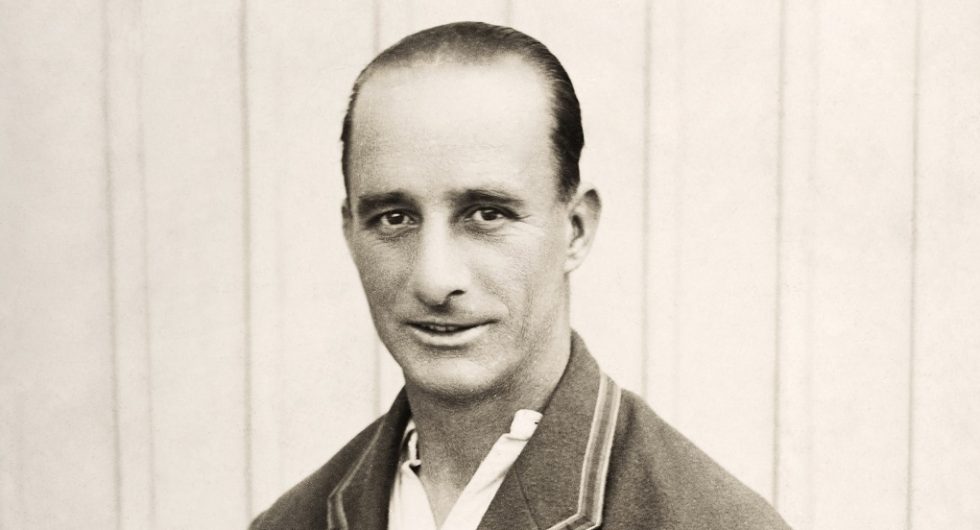
A similar tale comes from England, of Alfred Percy ‘Tich’ Freeman, a leg-spinner who completely enthralled the cricketing world with his bowling. A tale of a bowler who terrorized the batsmen of his generation. A tale, one can simply not afford to ignore.
Born at Lewisham in 1988, Freeman played his early cricket for small clubs and teams on the grounds of Essex. But it was in the neighbouring county of Kent, where he would go on to claim all major accolades of his career. Starting with their second team, Freeman worked his way up into the main squad, going on to play more than 500 first-class matches for the Kent County Cricket Club.
Freeman’s diminutive figure earned him his nickname, ‘Tich’. A name that would be attached with him for the remainder of his life and career, but a name that was far from his stature on the cricket field. Standing only a little over 5 feet tall, Freeman enjoyed the benefit of a low-release point, thereby giving the ball a lower trajectory as compared to other spinners (A technique used effectively well by Muttiah Muralitharan as well). His short strides and brisk action made it further difficult for the batsmen to pick him up. Another unique facet of Freeman’s bowling was his unorthodox grip on the ball. An orthodox grip for leg-spin requires the bowler to hold the ball between his thumb, index finger and ring finger. Freeman, meanwhile, used his thumb, ring, and middle fingers. He even had a couple of variations up his sleeve, in the form of flipper and googly. All in all, Freeman was a handful for batsmen. A bowler who had to be carefully navigated and could be played with a straight bat only.
But by the start of 1914, just as Freeman was cementing his foothold in the Kent team, the World War forced the domestic competitions to be abandoned all over the world. That period was an extremely tough one for cricket. With hundreds of players listing themselves with the army, it was not long before The Wisden Almanack’s obituary column started flowing with the names of many players. There were many as well who did survive the war but were disabled due to injuries and therefore had their careers cut short. With the war eating up four years, and a brief failed experiment with two-day county matches, first-class county cricket resumed only in 1920.
Freeman had his plans sorted out all along. He was not going to let the war bog down his cricketing career. He waited. Just as a tiger waits, still and motionless, looking for the right time to pounce onto its prey. The resumption of county cricket saw ‘Tich’ Freeman produced some of the finest cricket of his career. He turned to-pick a truckload of wickets into a menial task. Freeman scalped more than 100 wickets in consecutive seasons in the early 1920s. His continuous performances at the top level ensured that Freeman was named a Wisden Cricketer of the year in 1923. That year’s almanack went on to describe a performance of Freeman’s as one of the finest they have witnessed. It came against Surrey. Chasing a total of 290, Surrey were in cruise control at 257 for the loss of 2, thanks to Hobbs and Sandham. But ‘Tich’ spun his magic web and managed 3 wickets in quick succession. Though Surrey scampered through in the end and won by 3 wickets, Wisden Almanack stating: “Freeman had paralyzed the batsmen”, speaks volumes of his abilities as a bowler.
But the first half of the decade was merely the tip of the iceberg. These performances were only a hint for the storm that was about to hit the English County Cricket in the coming years. In 1928, Tich Freeman went on to claim 304 scalps in a single season – a record for most wickets in a single season that still stands to this day. His list of records doesn’t end here. He went on to produce performances and figures that were simply mind-boggling. Freeman was the highest wicket-taker in an English County season 3 more times; in 1930, 1931 and 1933. Picking 10 wickets in an innings is an ultimate desire for every bowler. They toil, day after day, innings after innings, to produce that magical spell where they send an entire side back to the pavilion. Tich Freeman managed to do that 3 times! And though, 10 wickets in an innings have been claimed by several bowlers, only 4 have managed to do it more than once, and none except ‘Tich’ has done it more than twice. Freeman once managed to take 17 wickets in a match against Warwickshire in 1932; a feat that has been bettered only once (by Jim Laker, who famously picked 19 wickets vs Australia in 1956), and replicated only twice post World War II. Such figures, show the sheer dominance that Tich Freeman has had on the stat-charts. Over his entire first-class career, Freeman managed 386 five-wicket hauls and 140 ten-wicket hauls. Both tallies being individual records that are still unbeaten. To put these numbers into perspective, we look at the two modern greats of spin bowling – Shane Warne and Muttiah Muralitharan. Their five-wicket hauls stand at 69 & 119, and ten-wickets in a match tally at 12 and 34, respectively. Undoubtedly, Freeman played more matches than Murali and Warne, but his figures are baffling and awe-inspiring nonetheless.
But like most things in the universe, a cricketing career has its ebbs and flows too. Freeman had his fair share of ebbs, accompanying his flows, throughout his career.
With hordes of wickets, season after season, Freeman got the call-up for the England team in 1924. Touring the mighty Australians, Freeman was not able to produce the same magic that he managed back home. The skilful Aussies, with sound technique and footwork, made light work of Freeman. On tour, against the Proteas in 1927/28, his returns of 14 wickets in 7 matches, could barely be termed as decent, when compared to his domestic track record. These initial failures with the national side, finally gave a window of opportunity for his critics to pounce upon. They claimed that Freeman had nothing to show for performances other than his meticulous work rate. It was claimed that; for Freeman to be effective, either the pitch needs to have some juice for spinners, or the batting side has to be weak. In the return tour, when South Africa visited England, Freeman’s performances improved a notch, where he picked 22 wickets in two matches. However, the last match of the series saw the spinner go wicketless for 49 overs, conceding 169 runs. This shabby performance, sadly, drew curtains over his short-lived national career. A much-awaited prospect got reduced to only a what-if, all in a couple of years. Though, looking at his stats, 66 wickets in 12 matches, one would say it was criminal to have dropped him from the side! But that is how cruel the sport of Cricket can be.
Out of the national set-up, Freeman continued being a key figure for the Kent team until 1934/35. His form in the county dipped over the next two seasons and he parted ways with Kent after the 1937 season. Eventually, ‘Tich’ Freeman called it quits after a couple of seasons in the lower district leagues. By the time he retired, Freeman had amassed a total of 3,776 wickets, sitting second on the list of most wickets in first-class cricket. He opened a sports equipment’s shop later on and was granted life membership of Marylebone Cricket Club in 1949.
Despite having a colossal career, ‘Tich’ Freeman, only remains a name on a list. For a man, who locked horns with greats like Jack Hobbs, Herbert Sutcliffe and Wally Hammond, the annals of history have failed to retain the glimmer that Freeman brought to the game. Perhaps, his failure with the national squad was his undoing. His national team records may suggest that he was no Grace or Compton, but Cricket will remember him as an ardent student of the game, a devout acolyte who breathed life into spin bowling, an art that would be picked up and savoured by the generations to follow.
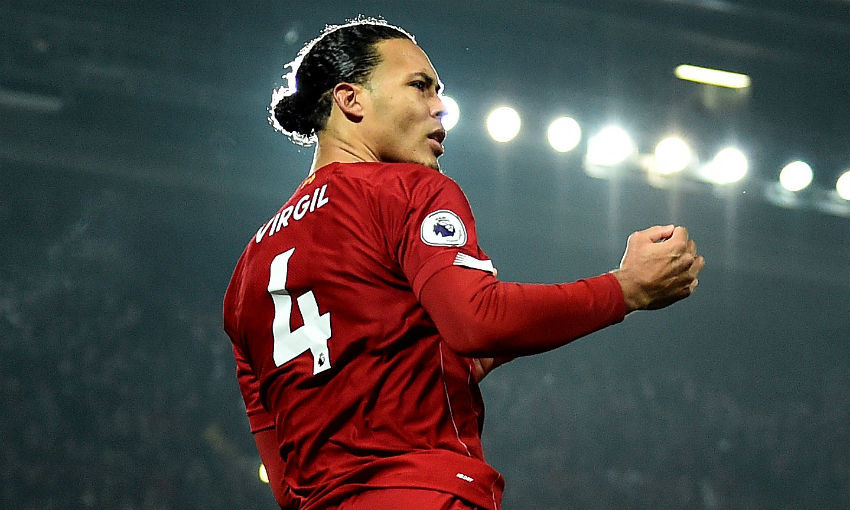
“He’s our centre half, he’s our number four; We watch him defend, we watch him score; He’ll pass the ball, calm as you like; He’s Virgil Van Dijk” These are the lyrics that echo around every nook and corner of Anfield and the city of Liverpool. Such has been the impact; the talismanic Dutch centre-half has had on the Reds. With his ratings rising steadfast, Van Dijk is being compared to few of the finest defenders to have graced the Premier League: the likes of; John Terry, Rio Ferdinand and Nemanja Vidic.
But are these comparisons justified? Is Virgil Van Dijk really that good?
With their coffers full from the Coutinho sale, Liverpool lavishly spent on a centre-back, acquiring the Dutch defender for a fee of £75 million. A record, that was broken eventually by Mr. ‘Slabhead’ Maguire. A price-tag such as that surely comes with a baggage of expectations. Taking recent examples in the world of football, big money signings have struggled under that pressure. Be it Neymar at PSG, Coutinho and Dembele at Barcelona or more recently Nicolas Pepe at Arsenal, all big money signings have been plagued by issues ranging from injuries to lack of morale and confidence.
But Liverpool on the other hand, have gotten themselves a player worth every last penny. Van Dijk over the past two seasons has been stellar. He has been composed under pressure and has earned the right to don the captain’s armband. His rise at the club level, has been paralleled with the national team as well. At hindsight, we can say that him and Alisson were the final clogs in the machinery that Jurgen Klopp had been building over the past couple of seasons. Van Dijk has been a pivotal piece of the juggernaut that has steamrolled the Premier League this season. His focused, laser-sharp defending coupled with his aerial abilities has been a menace for almost every team Liverpool has faced. Add to this, his long-range passing ability. Virgil Van Dijk is a complete package, without even the slightest of doubt.
The fans have showered him with admiration and appreciation, and rightly so. But at the same time, there is a faction overpraising VVD, and in process undermining the contribution of the other players. What Liverpool are today – a well oiled machinery – is a result of top notch performances from not only Van Dijk but also TAA, Henderson, Alisson and their electrifying front three. But such overpraising, from football communities the world over, has started a chain of discussion claiming that Virgil Van Dijk belongs to the top rung of defenders who have played in the Premier League in the recent times i.e. Terry, Vidic and Ferdinand.
Such claims might be a bit unwarranted.
Virgil Van Dijk may be head and shoulders above all current defenders in the league, but he is yet to match the names mentioned above, which also includes players like Sol Campbell, Jap Stam and Vincent Kompany. Some of these names have been the personification of dominance over the past years. The Duo, Vidic and Ferdinand, were a part of the Manchester United team that had absolutely annihilated the Premier League for an entire decade, winning 3 back to back Premier League titles, twice! Ferdinand in particular, was exceptional with his feet, building play from the back – a trait that is extremely desirable from a centre back in the modern game. Going a bit further in United’s past, Jap Stam was another stellar figure in the heart of the team’s defence and a member of the famous treble winning side of 1998/99. But inarguably, the leader of the lot has to be John Terry. Despite having a notorious image off the field, JT never let that weigh him down on the field. He was a part of the Mourinho side that redefined the Premier League; winning successive titles with a game-changing 4-3-3 formation. A formation which has now become a standard approach for almost every manager. JT continued his dominance post Mourinho’s tenure, winning a domestic double under Ancelotti and the much-coveted Champions League trophy in 2012. All these milestones while leading the pack from the front. By the time Terry retired from the game, he was the league’s highest scoring defender as well as had the most clean-sheets. In 2011, he was third on the list of passing accuracy with 91.6% accuracy, behind only Xavi. Dominant aerially and rock-solid on ground, it is only fair to say that Terry was who God produced, when the word ‘defender’ was mentioned to him. Premier League, time and again, has been graced by such defensive spearheads. Another example is former Manchester City captain Vincent Kompany, whose name is synonymous with perseverance. Signed by the club in 2008, Kompany was a part of City’s meteoric rise to the top of English football; as they stepped out of the shadow of their mighty Manchester rivals and went on to claim four titles in a span of seven seasons. He is the true embodiment of the phrase: ‘Captain. Leader. Legend.’ Perhaps, the only feather missing from his cap is the Champions League trophy, which has eluded City for long now, but Kompany was a gritty player nonetheless.
Another facet that sets these legends apart from others, is pedigree! The sheer number of trophies won by these players. Since ultimately, what fans want to see the most is their team win and stack up silver-ware. And though, Liverpool have been on the ascendancy for the past couple of seasons, one Champions League and one Premier League (despite it being the much sought after first title) are not enough to get you in the elite company. These stalwarts simply show that what Van Dijk is currently doing, has been achieved by many prior to him and that too for a prolonged period of time.
Now, all of this does not to imply that Virgil Van Dijk is any less of a defender, or that he lacks the ability to be the best. In fact, VVD shows many traits, resembling to all these players during similar stages of their careers. But pitting Van Dijk, as phenomenal as he may be, against the likes of Terry and Ferdinand, just yet, is frivolous and childish. To put it metaphorically, Van Dijk is in the middle of a marathon, one that his predecessors have already completed. It would be unfair to say that he cannot complete it, and at the same time rash to say that he’ll better the timing of the others before him. One can only know his greatness and legacy, for sure, when he will complete the marathon.
Until then, we fans can merely enjoy the stoic beauty that Van Dijk is while on the field.





 Sports Lane