They had Sobers, they had Gibbs, they had Holder; but you know how it goes, right?
“It was Gavaskar, the real master;
Just like a wall, we couldn’t out Gavaskar at all;
Not at all,
You know the West Indies couldn’t out Gavaskar at all.”
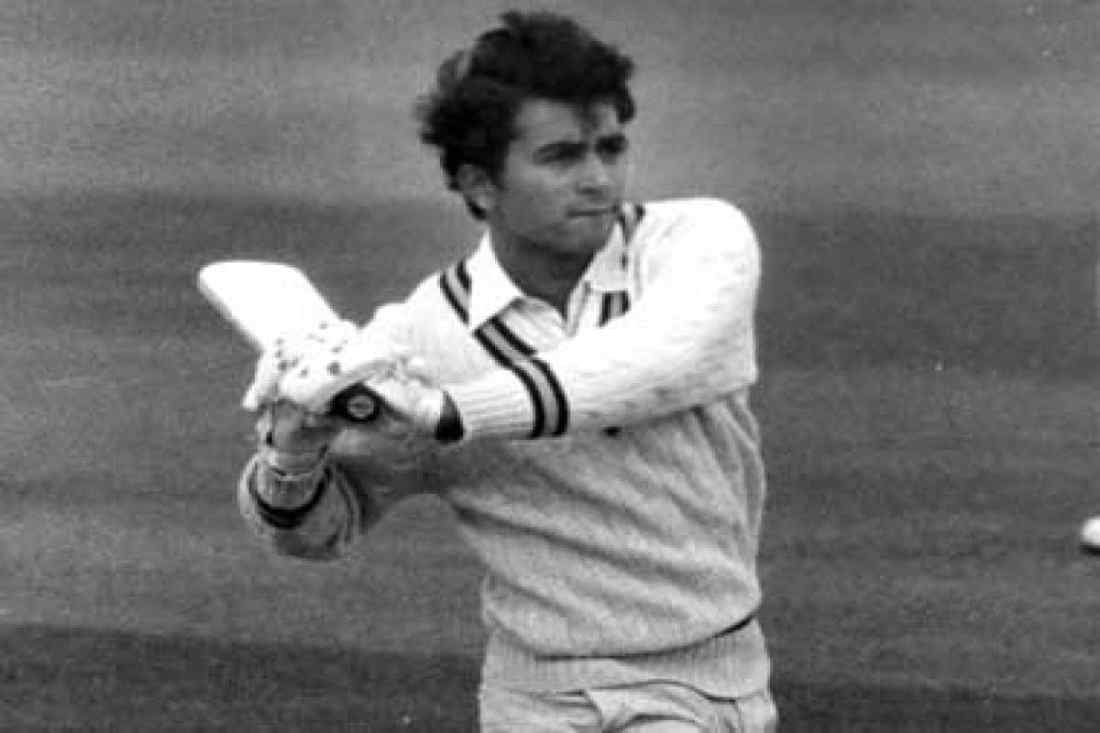
These are the lines from Lord Relator’s Calypso Beat titled ‘Gavaskar’, made in tribute to the Indian Cricket team’s maiden Test series win in the Caribbean in 1971. The series saw 21-year-old Sunil Gavaskar make a swashbuckling entrance on to the international stage. This tour proved to be a teaser-trailer of Sunny’s batting exploits the world would treat itself with, in the years to come.
For the West Indies, in particular, Sunny always had the most special of innings reserved in his willow. Almost like a person, smitten in love, laying a precious piece of his heart, at the feet of his lover. We track how Sunny’s romance with the Windies brew, as he moved along his career.
The debut tour to West Indies, 1971 – Love at first sight.
India had conceded a home series to Australia in ’69 and were looking for vindication. The tour up ahead was against the mighty West Indies, led by the colossal Garfield Sobers. For India, the onus was on the big-guns like Jaisimha, Wadekar, Sardesai and the spin-trio of Prasanna-Bedi-Srini. Little did we know that it would be a young lad from Mumbai, who would decimate the West Indies hopes.
A whitlow ensured that Gavaskar could debut only in the second test of the series. The first test was a draw that saw Sardesai and Kanhai score big hundreds, with the Indian mounting his second double century. The action now moved to Port of Spain.
In the second test, for the first time, out came a young, five-foot-five Mumbaikar, to open the innings for India. Gavaskar managed a fifty and India had a sizeable 1st innings lead. Vice-Captain Venkataraghavan took a 5-fer in the second innings and West Indies were bundled out, giving India a target of 124. Gavaskar, steering the team to victory, managed an unbeaten 67. Such calm and poise from a 21-year-old was exemplary. India wrapped up a win in 4 days and took a 1-0 lead. Port of Spain, however, was yet to see the best of Gavaskar on that tour.
Gavaskar continued his form in the third test. Trailing by 363 runs, Gavaskar anchored the innings on his way to a maiden test century. Sunny navigated marathon spells from their premier bowlers – Gibbs and Sobers – until he was caught by Carew off Sobers on 116. He followed this with an unbeaten 64 in his second stint at the crease while chasing 294. An equally astute knock from fellow opener Ashok Mankad meant that India drew the third test as well.
In the fourth test, Gavaskar was out for 1 in his 1st innings, an aberration in his dream debut series. However, he made up for the 1st innings slip-up by managing an unbeaten 117. But the value of this century was much more. India, chasing 335, found themselves reeling at 3-79. Gavaskar dug in and gritted out a draw for his team. His innings lasted over five hours and he managed to stay at the crease for 103 overs. India’s lead was now unassailable. But the contest, against that West Indies side, was never over. Gavaskar too was up for the challenge, and the little master had saved his very best for the last test match.
Back in Port of Spain for the last match, Gavaskar started immaculately with a score of 124, leading the batting line up from the front. This was Gavaskar’s third ton in consecutive matches. Unfortunately, centuries from Davis and Sobers meant that India had conceded a 166-run lead in the 1st innings. But yet again, it was Gavaskar who paved way for his team with a double century in the second innings. He became only the third Indian to score a century and a double century in the same match. Gavaskar did not allow an inch of opportunity to the hosts. The entire bowling line up was rendered ineffective. When he eventually got out, Sunny had ensured that India were in a safe position with a lead worth more than 200 runs.
The match ended in a draw. India got the series.
Sunil Gavaskar, this short and skinny boy, all of 21 years; had plundered the mighty West Indians in their own backyard. He had scored a total 774 runs in 8 innings, three of these were unbeaten. I’m leaving the average for you to calculate. During the series, Sunny managed to stay at crease for more than 1700 minutes or close to 30 hours. Not too bad for a debutant!
Sunny surely belonged at the highest level. He was more than eager to take on the world and he would stop at nothing.
Gavaskar was not to encounter Windies again until 1974/75.
West Indies tour of India, 1974/75 – A brief re-encounter.
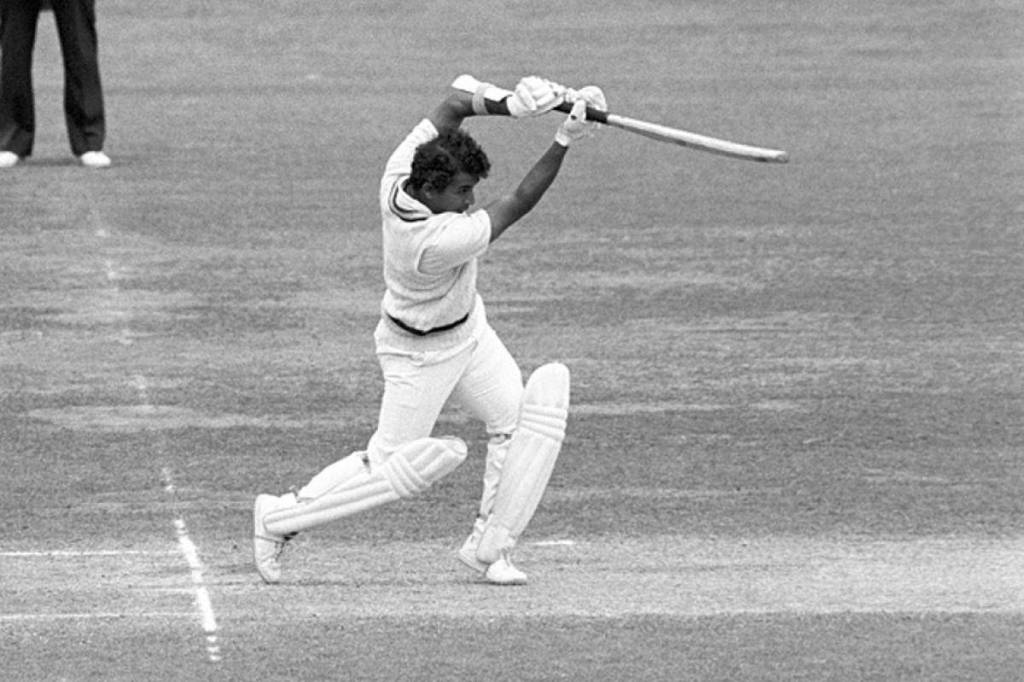
West Indies had been subjected to chopping and changing. The Sobers era was over. Clive Lloyd held the reigns now. The new team was a blend of experience and youth. Old faces, the likes of Holder, Gibbs and Fredricks, were accompanied by newcomers like Greenidge, Viv Richards, Kallicharan and Andy Roberts.
Our little master, on the other hand, was bearing the brunt of the cut-throat world of international cricket. After a blistering start to his career, Sunny had failed to keep up with the reputation he had created for himself. Some critics were demanding his head after a couple of mediocre series against England.
But was this the opportunity to regain his form? Though featuring a few new faces, it was against this very team he made a remarkable entry on the world scene. Could Sunny prove the critics wrong now?
Unfortunately, that was not to be.
Sunil Gavaskar got injured while playing in the Ranji Trophy and could only play the first and the last matches of the series. India lost both.
The series, however, was a rip-roaring seesaw battle between the two teams. West Indies won the first two, India followed up with winning the next two and the 5th match – the series decider – was taken by West Indies.
In the two matches that Gavaskar played, he managed a paltry 108 runs in 4 innings at an average of 27. His tryst with the West Indies was not over just yet.
India in West Indies, 1975/76 – Everything is fair in love and war.
India arrived in the Caribbean on the back of a successful tour of New Zealand. Sunil Gavaskar had gotten the first taste of captaincy in New Zealand after an injury ruled Bishan Bedi out of the first test match. The series was a fruitful one with the bat as well where Sunny managed 266 runs in 3 matches at an average of 66.
The little master was back where it all started for him.
The first test was a nightmare start to the tour as India conceded the match by an innings and 97 runs. Gavaskar got off to a steady start in the 1st innings but failed to capitalise and fell for 37.
The action now shifted to Port of Spain, where Sunny scored a double ton on the previous tour. And like two lovers, Sunny and Port of Spain reunited. His touch was back. It was almost as if he felt at home in the confines of the Queen’s Park Oval. He felt complete. In the 1st innings, Gavaskar scored 156 runs in 352 balls. It took the West Indies bowlers 485 minutes to send him back to the pavilion. Such mammoth knocks, where Sunny dug deep into his reserves of patience, were becoming a trademark of his. India batted only once in the test and it ended in a draw.
The third match was, again, at Port of Spain. India were given the gargantuan task of chasing 403 runs in the 4th innings. But you already know what happened next. Sunil Manohar Gavaskar came to the fore! How could he have not? He set up a beautiful chase with an exhilarating knock of 106 runs. His fourth century at the Queen’s Park Oval. The momentum was carried forward by the ever-dependable Jimmy Amarnath and Viswanath. India won by 7 wickets and the series was all square.
But like all relationships, this one had to go through rocky patches as well. This was evident in the fourth test match of the series. The West Indies resorted to bodyline tactics to counter the Indian batting attack. Things got ugly. A lot was talked about in the media, India complained and West Indies hit back.
It started well for India with both openers getting half-centuries and India was 1 for 175 at the close of Day 1. It was on Day 2 that the endless barrage of bouncers was unleashed on India by Clive Lloyd. Anshuman Gaekwad, Gundappa Viswanath and Brijesh Patel fell prey to the controversial tactics and could not play a further part in the match. After his dismissal in the 2nd innings, Gavaskar infuriatingly walked off the field and kept mumbling and questioning the tactics all the way to the pavilion. India had no answer to such lethal fire-power and could only manage to set a target of 13 runs and the West Indies won the match by 10 wickets and took the series 2-1.
West Indies tour of India, 1978/79 – Affection and Addiction.
When the West Indies came to India; they no longer had to face the young Sunil Gavaskar, the boy who was touted to be a world-class batsman. On this tour, they were up against Sunil Gavaskar – the prolific opening batsman. Sunny had taken every challenge head-on and had amassed runs in every corner of the world. Gavaskar was now counted among the best batsmen in the world. He was particularly successful in Australia and Pakistan, averaging over 50 in both countries. He was rewarded for his stellar contributions by being named as the captain of the side.
West Indies, meanwhile, were world champions and a force to be reckoned with! Their bowling had created a reputation for themselves. Destructive and lethal were a few words which were synonymous with their line-up.
In the first test, Lloyd won the toss and asked India to bat. That decision backfired. Sunil Gavaskar, as elegant as ever, dished out his second double century with a score of 205. In the absence of Holding and Roberts, Gavaskar tormented the West Indies bowlers by staying in the middle for almost 7 hours. What was even special was that this innings came in front of his home crowd at the Wankhede in Mumbai. A sound batting performance by the West Indies ensured a draw. Gavaskar had added another 73 into his tally in the 2nd innings.
Despite not meeting for close to three years, the affection for West Indies was just the same. Deep inside that colossus of a man, there still was a 21-year-old who debuted in 1971. The young bloke for whom the paramount motive of representing his country was the joy and love for the game. That love was palpable when watching the ‘Little Master’ bat.
Sunny continued on his stellar run of form with a century in each innings of the third test of the series. In the 1stinnings, his knock worth 107 made sure India put on a respectable score on board. In the 2nd innings, he and Vengsarkar brought pillage onto the West Indian bowling. Both managed unbeaten tons on their way to a partnership worth 344 runs for the third wicket. Sunny scored 182. India came tantalizingly close but a win ultimately eluded them as they could only pick 9 wickets in the last innings thereby giving a reprieval to West Indies. The series was still square.
The fourth test was a low scoring one, and though Gavaskar did not get big runs, he was meticulous in his man-management and tactics as India got the all-important win and took the lead in the series.
By the start of the fifth test, an already depleted West Indies team had been brought to its knees. The series continued on similar lines. In the fifth test, Gavaskar scored yet another century. Vengsarkar continued his phenomenal run. This series also brought limelight onto a young 20-year-old, a boy that would be known by the name of ‘Hurricane of Haryana’ later on in his career. India piled on 566 runs in their only innings but still failed to win the match.
The last match of the series was a high scoring draw with only two innings played. Gavaskar managed a paltry 40. But his series stats were: 6 innings – 732 runs – 91.50 average. It would be safe to say that Gavaskar was addicted to scoring against West Indies. This was his third consecutive series average of more than 50.
The Windies bowling battery comprising Norbert Phillips, Vanburn Holder, Sylvester Clarke and Parry, had been blown away. Their batting barely managed to get through, but some critics felt that against a weakened West Indies line up, India should have pulled off at least three more wins. But we’ll leave that discussion for another day.
India tour of West Indies, 1982/83 – A lean patch that every relationship has.
Indian cricket was seeing tumultuous times. The captain’s post had seen a many unsuccessful holders, including Sunny, until Kapil Dev was finalised for this series. Bedi, Prasanna and Chandra had called it a day and the team was in the process of a revamp.Due to this, naturally, the team had seen a barren run for the last season and a half where they managed only two wins in 21 test matches.
Sunil Gavaskar was on a similar topsy-turvy run. A couple of stints as captain had taken their toll on Sunny Gavaskar – the batsman. The scrutiny he faced had left a sour taste. Add to this, Gavaskar being involved in controversy during the tour of Australia in 1980/81 where he decided to walk off with his batting partner, Chetan Chauhan, after the umpire wrongly adjudged him out. Multiple dynamics were causing his batting setbacks.
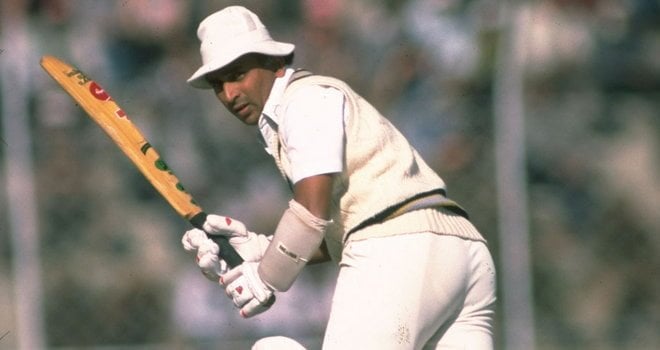
This West Indies tour proved to offer the same. Indians simply did not look settled enough. The four horseman of West Indies cricket – Marshall, Holding, Roberts, Garner – their ace bowlers, simply dismantled the Indian batting order to its very core. Gavaskar only had one hundred to show for this series wherein he scored 147 not out in the third test match. His next best score in the series was 32. He had four single-digit scores in nine innings and by the end of the tour, Sunny averaged a mediocre 30. With India losing the series 2-0, this turned out to be a forgettable tour!
This was Sunny’s last tour to the Caribbean islands. And it was surely not the most memorable of outings, but life had its own plan ready. The very same year India went on to win the Prudential World Cup in England. A victory that sparked fresh life into Indian cricket and flamed the fire for generations to come. Sunny was a part of that squad and how fitting it was that India defeated West Indies in the final.
West Indies in India, 1983/84 – A memorable goodbye!
The kick-back into test matches following the exhilarating highs of limited-overs cricket started on a decent note for India and Gavaskar. The three-match series at home, against Pakistan, was drawn and Gavaskar scored 264 runs at an average of 66. But the challenge ahead was stern!
Despite going down in the World Cup final, the West Indies team was a formidable one. Their top-3 of Haynes, Greenidge and Richards was probably the finest in the world. Their bowling was a menace too!
But why this series was cherished by the Indian faithful, was because Gavaskar had broken two of the most eminent records in the history of the game. India got off to a terrible start as they were quashed in the first test. With a day and a half to spare! Gavaskar too, struggled and managed a duck and 7 runs in his two innings. But he was about to make up for this performance in the following match.
When one thinks of Gavaskar, the first words that come to mind are patience and resolve. Throughout his career, Gavaskar played numerous innings where he glued himself to the middle and let the bowlers toil. The opposition would try their best to lure him into a bait, to make him play a false shot but the ‘Little Master’ never budged. This was meditation to him. And because of this traditional approach of Sunny’s, the innings he played at Kotla; in the second test, became all the more remarkable. Marshall had his plans for Gavaskar clear. He was going to bowl bouncer after bouncer. But Sunny was ready for everything. He hooked, he pulled, he then hooked again and he pulled again. Gavaskar had a swift answer to every question that was posed to him. West Indies had not seen this Gavaskar at play, ever! Sunny managed to reach his century in 94 balls. Yes! Sunil Gavaskar scored a century at less than run-a-ball, let that sink in. It was unbelievable that there was an entirely unseen, flamboyant side to his batting as well, a side that automatically came to the fore when the need arose. What further alleviated this gem of an innings was the fact that Gavaskar had equalled the world record for most centuries in test cricket at 29. Oh, and just slide another fact in as well! Whose record did he equal? – The Don’s! Gavaskar brought up his 8000th career run in the course of this innings as well.
In the following match, Gavaskar scored a 90 in the first innings and became the highest-scoring player in test cricket. But the subsequent drought of runs from his bat was abysmal. Gavaskar managed only 35 runs in next two matches. Things got out of hand in Calcutta, where the crowd vented out their frustrations with the team and pelted the team bus with stones.
But in his last test match against the West Indies at Chennai, Gavaskar succeeded in giving his fans one last hoorah. After conceding 313 in the first innings, India found themselves reeling at 4-69 at the end of third day’s play. Gavaskar; who for a change, had walked in at number 4 position, had an uphill battle to face the next day. Sunny did what he knew best. He dug in. He got little support from the other end but relying on his basics, Sunny played an astonishing knock that lasted over ten hours. He finished at an unbeaten 236 off 425 deliveries. And just like that, his last innings in his tryst with West Indies came to an end.
Despite his heroics, he could do little to prevent the 3-0 series defeat.
Right from the young prodigy to the dependable stalwart of the Indian team, Gavaskar faced West Indies at crucial junctures of his career. Be it the first series as full-time captain or when he had to prove himself to the critics, West Indies was the opposition. Over his career, Sunny faced the side in 48 innings. In these 48, he totalled 2749 runs at an average of 65.45. Of the 13 tons he scored against them, 3 ended up being double centuries. When these two met – sparks flew, and magic was kindled, it used to be cricket at its purest. And to a few of the cricket fanatics, it was no less than romance. The glorious ‘Sunny days’ lasted till 1987 and Gavaskar made all oppositions kneel down to him just the same, but I am fairly certain that West Indies would have a special place in his heart. Well, we’ll have to ask the legend himself to be absolutely sure.
 Sports Lane