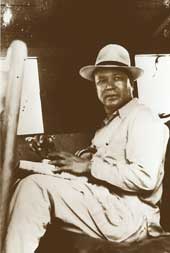
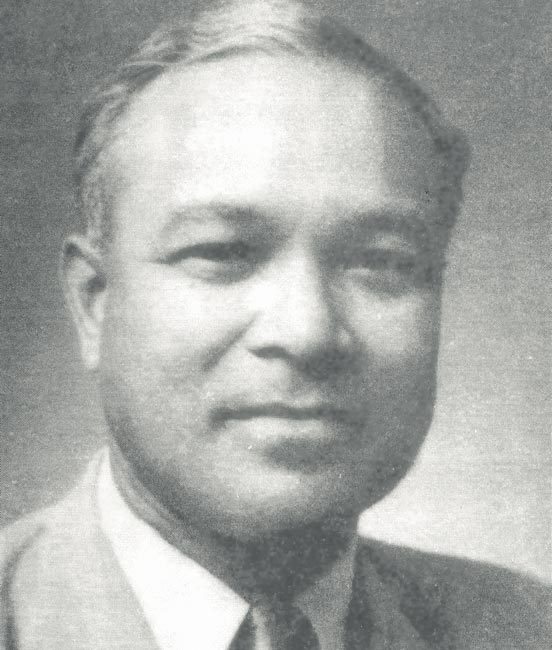
1928 Olympics in Amsterdam gave the world a star. A 22-year-old Lance Naik from the Indian Army, named Dhyan Chand, enthralled the audience, made journalists and viewers suspect the laws of gravity and infuriated the officials to an extent wherein they had to break open his stick to check for magnets inside. Well, some of this is hearsay but Dhyan Chand’s tally of 14 goals in 5 games, can describe India’s domination in the 9-team tournament as accurately as possible. India scored 29 goals and conceded none. But in this team of champions, there is one person who is often overlooked. Probably because he stumbled just before the final hurdle, but that hardly makes his contribution any less important. He was a person who graciously contributed to not only hockey but human lives as well. It was the captain – Jaipal Singh Munda.
Promod Pahan was born in 1903, in Takra village in Bihar’s Ranchi province. He belonged to a family of forest dwellers of the Munda tribe, who were known as ‘janglis’ or ‘adibasis’. His parents, who were tribal farmers, had embraced Christianity and as a result, Promod was enrolled in Ranchi’s prestigious St. Paul’s school under a new name ‘Jaipal Singh’. This is where Jaipal’s prodigious talent came to the fore.
The school principal Canon Crosgrave, recognizing his talent, took Jaipal under his wing and brought him to England in 1918. In 1922, Jaipal Singh got enrolled in the University of Oxford. This was where Jaipal got acquainted to the sport of Hockey. He wasn’t the tallest of figures on the field, but his command and control over the stick aided him in becoming a dependable deep-lying defender. His hard hits and tackling, he worked upon and improved with time. Soon enough, he was an Oxford Blue in hockey. But merely being in the team was never enough for Munda. He was meant to be a leader.
And as fate would have it, Jaipal Singh Munda was chosen to lead the Indian Hockey Team in their first-ever appearance in Olympic Games in 1928. There were ripples of dissent with his appointment, but Munda never bothered himself with speculation and rumours. His sole focus was on leading his 16-member team to victory. He was one of the three players hailing from Britain alongside Syed Yusuf and Nawab of Pataudi Sr. to be selected in the squad. India played a friendly game in London en route to Amsterdam. Such was the power of their performance in that match, that it is believed the England team, who were watching India play, decided to withdraw from the Games fearing they’ll face a humiliating defeat if pitted against that Indian side. This was the same England team that had bagged a Gold in the 1920 Olympics.

The Indian team, to the surprise of everyone, completely steamrolled every opponent they faced. In the four group games they faced against Austria, Belgium, Denmark and Switzerland, India scored a total of 26 goals and allowed none. Nobody, well; apart from the England side, expected the newcomers to outclass all opponents. But just before the final, India were handed a major setback. Jaipal Singh Munda decided to pack his bags and return to London. The reasons for this withdrawal are still unknown and speculated to a large extent. Some claim that he had a rift with the team manager, while others say that he had to return to appear for his Civil Services exams. Luckily for the Indian team, their vice-captain Eric Pinniger took charge and they won by a scoreline of 3 goals to nil. Dhyan Chand was the star again, with a hattrick in front of a jam-packed Olympic Stadium which seated 24,000 spectators. Unfortunately for Munda, that was the last he would see of the green turf of a hockey field.
Jaipal Singh Munda’s streak of bad luck did not end at the Olympics. Back home, he was debarred from the Civil Services exams, claiming that he had flouted terms of his probation period by joining the Indian team in the middle of his service tenure. Miffed at the prospect of repeating a year, he decided to quit the profession and took up teaching in Ghana.
But as is the case with all visionary leaders, Jaipal Singh Munda was relentless. After returning to India in 1937, when he was the principal of Rajkumar College in Ranchi, Munda became aware of the atrocities that the people of his native village and its nearby areas faced. And the remainder of his life became a mission to alleviate those problems.
In 1940, he became the president of Chotanagpur Adivasi Mahasabha which was extensively involved in the demand of a separate state for the tribal natives. Jaipal Singh Munda was also elected to the Constituent Assembly in 1946, as a representative of the tribal population. Being an exceptional orator, some of Jaipal Singh’s speeches addressing the assembly hold a special place in the hearts of his admirers.
Today, 50 years after his demise, Jaipal Singh Munda continues to be a beacon of hope for the people and youth of Jharkhand. The state – Jharkhand – which Munda envisioned, is a hotbed of hockey talent in the country. Though the people still struggle for land rights and basic facilities, they now know how to fight for what they deserve. The credit for this, among others, goes to Jaipal Singh Munda. And as far as the sporting world is concerned, Munda will always be the first captain to get India a hockey gold.
 Sports Lane